Sunday, 28 October 2018

Mid-term Break

Mid-term Break


I sat all morning in the college sick bay
Counting bells knelling classes to a close
At two o’ clock our neighbours drove me home.


In the porch I met my father crying-
He had always taken funerals in his stride
And big Jim Evans saying it was a hard blow.


The baby cooed and laughed and rocked the pram
When I came in, and I was embarrassed
By old men standing up to shake my hand.


And tell me they were sorry for my trouble
Whispers informed strangers I was the eldest
Away at school, as my mother held my hand.


In hers and coughed out angry tearless sighs
At ten o’ clock the ambulance arrived
With the corpse, stanched and bandaged by the nurses.


Next morning I went up to the room, Snowdrops
And candles soothed the beside; I saw him
For the first time in six weeks. Paler now


Wearing a poppy bruise on his left temple
He lay in the four foot box as in his cot
No gaudy scares, the bumper knocked him clear


A four foot box, a foot for every year.
Seamus Heaney

Sunday, 21 October 2018

Seamus Heaney

Seamus Heaney 


Seamus Heaney was born in a small agricultural town in Northern Ireland. Heaney is an Irish poet and he won the Nobel Prize for literature in 1995. In 1957, he went to Belfast to study literature at queen’s University. Then, he worked as a lecturer in 1965, but he was highly worried over the continuous clashes between the Roman Catholic and protestants. So Heaney moved to the Republic of Ireland in 1972. Later he worked as a lecturer in Harvard University and the University of Oxford.


In his poetry, he mainly focuses at the physical and rural surroundings of his childhood in Northern  Ireland. His poems are often short, punctuated by the intensity silence of the people he describes.


Among the collection of his poetry, the most significant are
·         Strom on the Island
·         Perch
·         Blackberry-picking
·         Death of a Naturalist
·         Digging
·         At a potato Digging
·         Follower
·         Mid term break


Heaney’s latest was the English translation of the Anglo-Saxon epic poem ‘Beowulf”. It became the best seller in United states and United Kingdom in 2000.

Sunday, 14 October 2018

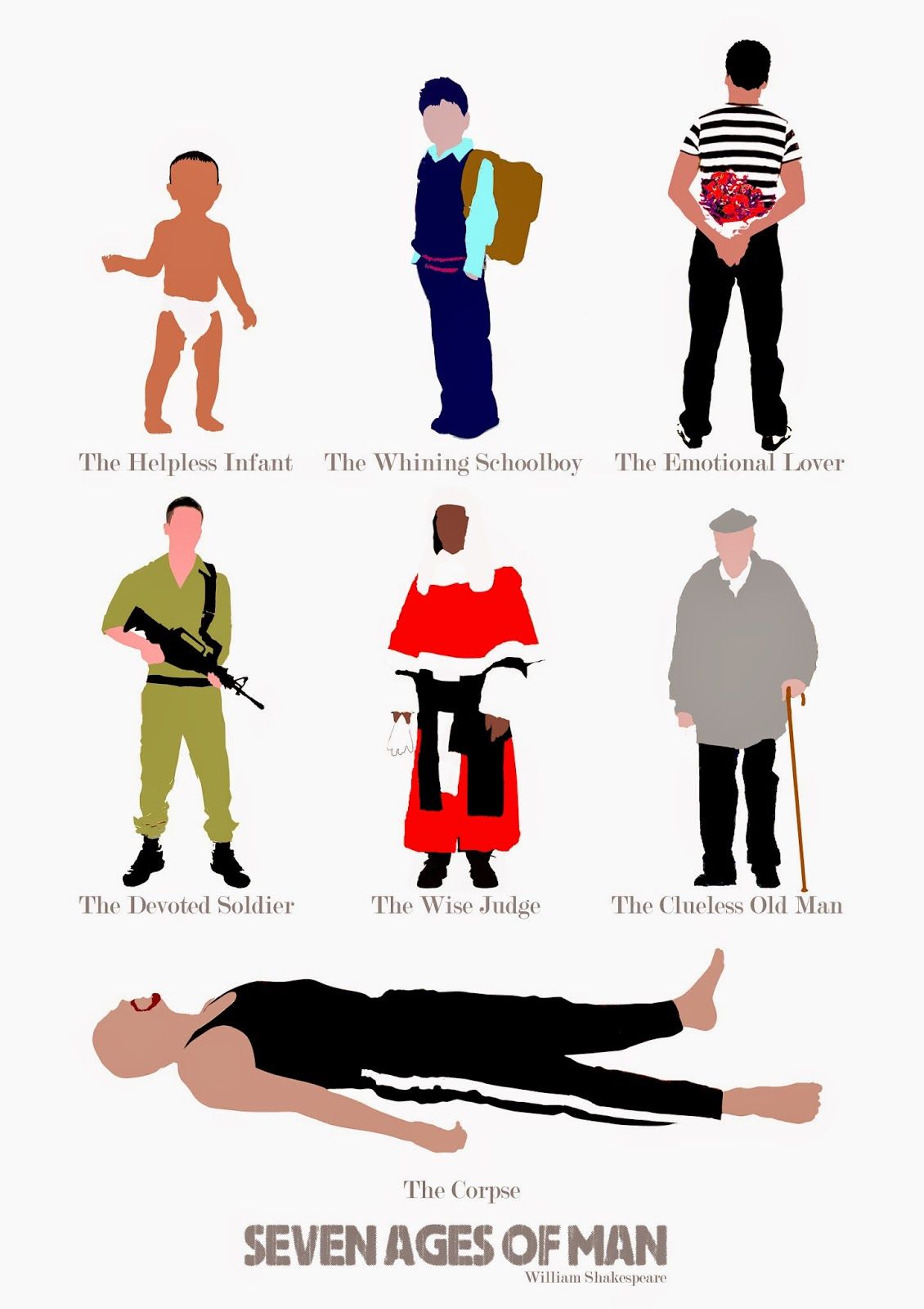
Review of the poem "The seven Ages of Man"

Review  of  "The Seven Ages of Man"


The Seven Ages of man written by William Shakespeare discusses about a person’s life, in its various stage from birth to death. During the life span of a person he/she has to undergo different experiences. The poet peeps into this wonderful nature of life. As a forward to this complexity of life, the poet brings an ideal definition.
               “All the world’s a stage,
                And all the men and women merely players”


He metaphorically takes the world as a stage. On this stage all men and women play as actors and actresses and the play different roles. They enter the stage and exist. With his effective metaphor, Shakespeare presents the reality of life as it is defined in many religions.


The poet brings out different characters to explain the stages of man. They are infant, school boy, lover, soldier, justice and old man. By using these characters, poet excellently derive the idea expected.


The poet also builds up of visual imagery of these characters. The reader can draw up the mental pictures of,      
          An infant who is mewling and puking
         A school boy who is whining and unwilling going to school
         A lover who is always sighing and singing woeful ballads
         A soldier seeking bubble reputation
        A justice who has a very well-informed look
        An old man wearing spectacles


Sunday, 7 October 2018

The Seven Ages of Man

The Seven Ages of Man 


All the world’s a stage
And all the men and women merely players
They have their exists and their entrances
And one man in his time plays many parts
His acts being seven ages. At first the infant
Mewling and puking in the nurse’s arms
And then the whining schoolboy with his satchel
And shining morning face, creeping like snail
Unwillingly to school, And then the lover
Sighing like furnace, with a woeful ballad
Made to his mistress eyebrow Then a soldier
Full of strange oaths and bearded like the pard,
Jealous in honour, sudden and quick in quarrel
Seeking the bubble reputation
Even in the cannon’s mouth. And then the justice
In fair round belly with good capon lined
With eyes severe, and beard of formal cut
Full of wise saws and modern instances
And so he plays his part. The sixth age shifts
Into the lean and slipper’s Pantaloon
With spectacles on nose and pouch on side
His youthful hose well saved, a world too wide
For his shrunk shank, and his big manly voice
Turning again toward childish treble, pipes
And whistles in his sound. Last scene of all
That ends this strange eventful history
Is second childishness and mere oblivion
Sans teeth, Sans eyes, Sans taste, Sans everything

William Shakespeare


Thursday, 27 September 2018

Review of "Disabled"

Review of "Disabled"


The poem “Disabled” by Wilfred Owen belongs to the Modern poetry of English Literature. The poem is about the various aspect of war. The central image of poem is, a disabled soldier in a wheel chair. By using this image Owen brings out realities related to war. “He” in the poem uses to symbolise all soldiers. Owen contrast the behaviour between a disabled soldier and other boys. Disabled soldier has an inactive behaviour while the other boys have active playful behaviour.


The disabled soldier suffers emotionally than physically. He is deprived in romance and his psychology scar is seemed to be sever than his physical disability. The poet increases the poignant quality.


The themes discussed through this poem are:
·         The plight of a physical handy crap soldier

·         Highlighted the bitter realities of war
§  War destroys human life
§  There’s no valid reason for war
§  War makes people dependent and helpless
§  War lacks glory
§  Irresponsibility of authorities elated to war
§  War is tragedy

·      Highlighting the idea that psychological scars are more painful than physical disability.


Disabled


Disabled


He sat in a wheel chair, waiting for dark,
And shivered in his ghastly suit of grey,
Legless, sewn short at elbow. Through the park
Voices of boys rang saddening like hymn,
Voices of play and pleasure after day,
Till gathering sleep had mothered them for him.
About this time Town used to swing so gay
When glow-lamps budded in the light-blue trees
And girls glanced lovelier as the air grew dim,
In the old times, before he threw away his knees
Now he will never feel again how slim
Girls’ waist are, or how warm their subtle hands,
All of them touch him like some queer disease.
There was an artist silly for his face,
For it was younger than his youth last year
Now he is old; his back will never brace
He’s lost his colour very far from here,
Poured it down shell-holes till the veins ran dry,
And half his lifetime lapsed in the hot race
And leap of purple spurted from his thigh,
One time he liked a blood smear down his leg
After the matches carried shoulder-high
It was after football, when he’d drunk a peg
He thought he’d better join. He wonders why….
Someone had said he’d look a god in kilts
That’s why; and maybe, too, to please his Meg,
Aye, that was it, to please the giddy jilts
He asked to join. He didn’t have to beg
Smiling they wrote his lie; aged nineteen years
Germans he scarcely thought of; all their guilt
And Austria’s did not move him
Of fear came yet.  He thought of jeweled hilts
For daggers in plaid socks; of smart salutes;
And care of arms; and leave; and pay arrears
Esprit de corps; and hints for young recruits
And soon, he was drafted out with drums and cheers
Some cheered him home, but not as crowds cheer Goal
Only  a solemn man who brought him fruits
Thanked him; and then inquired about his soul
Now, he will spend a few sick years in Institutes
And do what things the rules consider wise
And take whatever pity they may dole
To-night he noticed how the women’s eyes
Passed from him to the strong men that were whole
How cold and late it is! Why don’t they come?
And put him into bed? Why don’t they come?

Wilfred Owen


Wilfred Owen

Wilfred Owen 


Wilfred Edward Salter Owen was born on 18 March 1893 in Shropshire. He was a poet and a soldier. Wilfred Owen was the eldest son of the Thomas and Harriet Owen. He was an Anglican. During his school days, he was clever in studies. Wilfred passed the matriculation of the University of London. As the first career in life Wilfred worked as a teacher. In 1915, he was commissioned in the Manchester Regiment and was sent to the Front France at the end of same year. After periods at home, he returned to the front and paradoxically, was awarded the Military Cross.


Wilfred Owen was one of the leading poet of First World War. He wrote about war when he even at the battle field. Some of best works of him are,
·         Dulce et Decorum est
·         Insensibility
·         Anthem for Doomed Youth
·         Futility
·         Spring offensive
·         Strange Meeting    etc.


Wilfred Owen was killed in action shortly before the Armistice in November 1918. It was quite pathetic that Owen bade goodbye to his life at a very young age and he was killed one week before the Armistice, the agreement for the ceasefire was signed. After composing the poem, “Anthem for doomed youth” Wilfred Owen wrote a preface for it. It reads as follows:
 “My subject is war and the pity of war; The poetry is in the pity”
This is pathetic as well as ironic because the cruel war cost his life too.


Monday, 24 September 2018

Anthem For Doomed Youth


Anthem For Doomed Youth


What passing bells for these who die as cattle?
Only the monstrous anger of the guns
Only the stuttering rifles’ rapid rattle
Can patter out their hasty orisons
No mockeries now for them, no prayers nor bells
Nor any voice of mourning save the choirs
The shrill, demented choirs of wailing shells
And bugles calling for them from sad shires
What candles may be held to speed them all?
Not in the hands but in their eyes
Shall shine the holy glimmers of good-byes
The pallor of girl’s brows shall be their pall
Their flowers the tenderness of patient minds
And each slow dusk a drawing- down of blinds


Wilfred Owen


William Wordsworth

William Wordsworth


 William Wordsworth can be introduced as one of the most accomplished and influential of romantic poets. His theories and style are created a new tradition in poetry.


He was born in 1770 and educated at St, John’s College and later in the university of Cambridge. In his young age, he developed a keen love towards nature and during school vacation, he visited places noted for their scenic beauty.


Wordsworth began his career of poetry while a school boy. But his early poetry received little notice. When Wordsworth in Germany he wrote his finest lyric verses the “Lucy” poems.


Returning to England, he married Mary Hutchinson who was his childhood friend, in 1802. Wordsworth wrote most of his finest romantic poetry while he stayed in Dove. He loved solitude and never felt lonely in the presence of nature. He loved hills, valleys and lakes.


 As he advanced in age, his poetic vision and inspiration was dulled. 


William Wordsworth was died in 1850.


Sunday, 23 September 2018

She Dwelt among the Untrodden ways


She Dwelt among the Untrodden ways


She dwelt among the untrodden ways
Beside the springs of Dove
A maid whom there were none to praise
And very few to love


A violet by a most tone
Half hidden from the eye!
Fair as a star, when only one
Is shining in the sky


She lived unknown, and few could know
When Lucy ceased to be
But she is in her grave, and, oh,
The difference to me!


William Wordsworth